A faster way to fight deadly infections in liver disease
25 February 2026
People living with advanced chronic liver disease (ACLD) face a constant and often invisible threat: serious infection.
For patients with ACLD, including cirrhosis, infections are one of the leading causes of hospital admission and death. When the immune system is weakened and the body’s defences are compromised, even routine infections can become life-threatening.
Every hour counts. But the tools doctors rely on to identify infections are often far too slow.
This month, a new article published in npj Antimicrobials and Resistance explores how a cutting-edge diagnostic approach could change things. Led by Dr Merianne Mohamad (Postdoctoral Scientist) and co-led by Dr Vishal Patel (Principal Investigator), both of the ACLD Experimental & Therapeutics research group at the Roger Williams Institute of Liver Studies, and co-authored by Dr Chrysi Sergaki from the Medicines and Healthcare products Regulatory Agency, it examines how clinical metagenomics could transform the way infections are diagnosed and treated in people with ACLD.
Why speed matters in advanced chronic liver disease
When someone with ACLD develops an infection, doctors need to know two things as quickly as possible: the organism causing it, and which antibiotics will work.
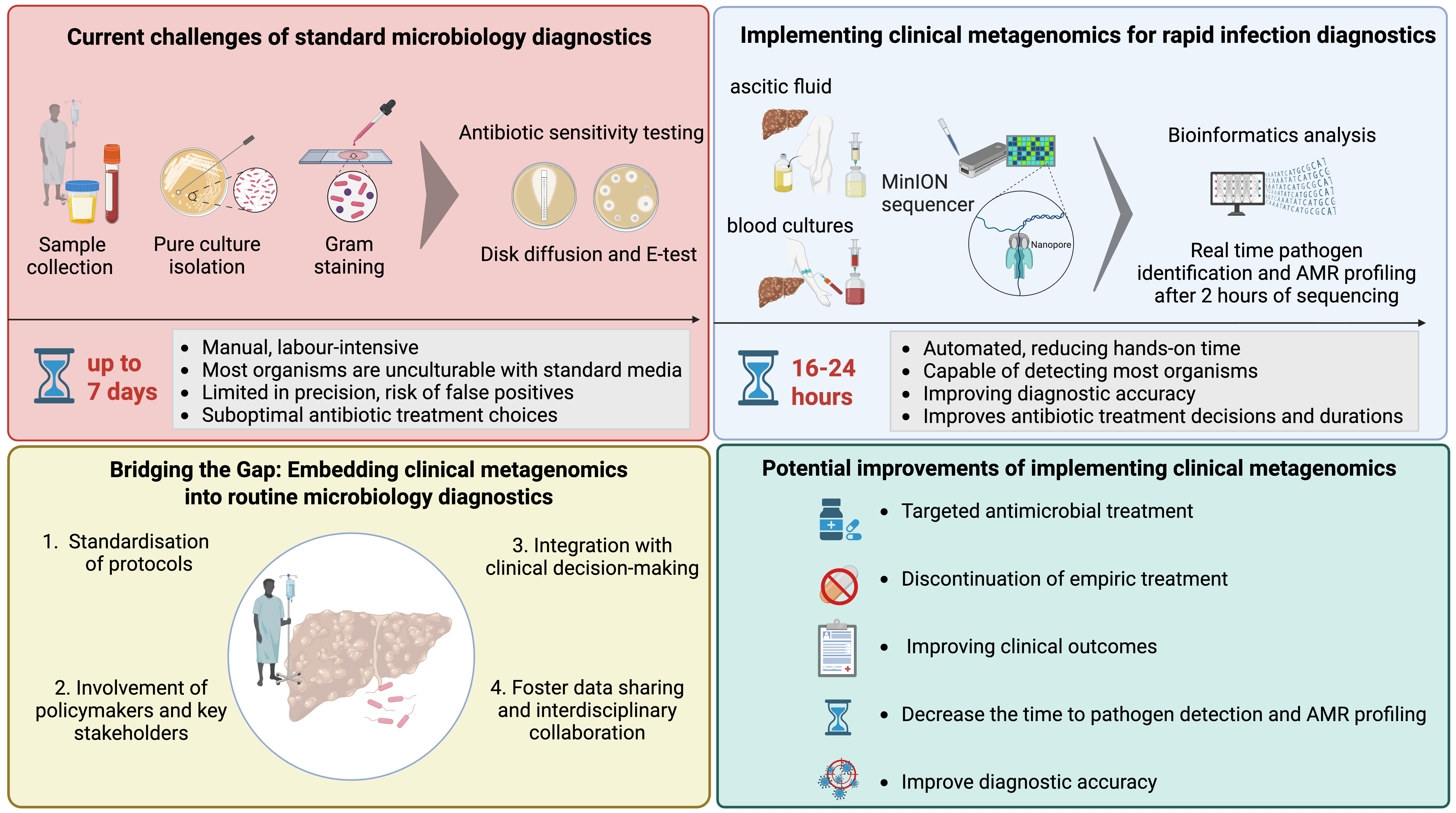
At present, this usually depends on growing bacteria in a laboratory (a process known as 'culture-based' microbiology). While reliable, it can take several days and sometimes fails to identify the cause at all, especially in complex infections.
Faced with uncertainty, clinicians are often forced to use broad-spectrum antibiotics as a precaution. While sometimes lifesaving, this approach can fuel antimicrobial resistance and expose patients to unnecessary and less-effective treatment.
“In advanced chronic liver disease, delays in diagnosis can be fatal,” explains Dr Mohamad. “If we can’t identify the infection quickly and accurately, we lose the chance to tailor treatment when it matters most.”

Dr Mohamad warns that the danger in advanced chronic liver disease is not just infection itself, but how slowly and at times inaccurately it's identified.
Spotting infections directly from DNA
Clinical metagenomics takes a very different approach.
Instead of trying to grow bacteria, it reads fragments of microbial DNA directly from patient samples such as blood or abdominal fluid. Using advanced sequencing technology, it can identify multiple pathogens rapidly and detect genes that signal antibiotic resistance.
In some cases, this information can be available within hours rather than days.
Dr Mohamad’s article outlines just how valuable this could be for people with ACLD, where infections are often caused by multiple organisms and standard tests miss key pathogens altogether.
Beyond identifying the infection itself, clinical metagenomics can also reveal how resistant bacteria are spreading within hospitals and help clinicians make more informed decisions about antibiotic use.
Promise, but practical challenges
The authors are careful to balance excitement with realism.
They highlight several hurdles that must be overcome before clinical metagenomics can be a part of routine care. These include the low levels of microbial DNA often found in liver disease samples, the complexity of interpreting large sequencing datasets, the need for standardised laboratory pipelines, and the upfront costs of sequencing.
But the authors also argue these costs should be weighed against the real price of delayed diagnosis: longer hospital stays, ineffective treatments, rising resistance, and families losing their loved ones.

“With the right validation and integration into antimicrobial stewardship programmes, this technology has the potential to save lives - not just by treating infections faster, but by using antibiotics more wisely.”
– Dr Vishal C. Patel, Consultant Hepatologist & Principal Investigator, Roger Williams Institute of Liver Studies
A wider impact across the NHS
While Dr Mohamad’s article focuses on ACLD, its implications extend much further.
The same challenges exist across critical care, transplant medicine, and other immunocompromised populations in the NHS, where infections are common, dangerous, and increasingly resistant to treatment.
This new research sits alongside the team’s broader work to raise awareness of infection risk in liver disease, including recent discussions in Parliament about the need for faster, more effective diagnostics. By making the case for clinical metagenomics in one of the most vulnerable patient groups, the authors hope to accelerate its adoption across healthcare more broadly.
For patients with liver disease, the promise is simple but powerful: faster answers, more precise treatment, and a better chance of recovery.
As antimicrobial resistance continues to rise worldwide, innovations like this may prove essential in staying one step ahead.
Click here to read the paper in full. Abstract below:
Read other news articles